Quick verdict
A one-ounce bar often gives a better cost-per-gram balance for a buyer able to commit more cash and sell the whole unit later. Smaller bars suit staged buying or partial exits but can carry materially higher percentage premiums. Choose recognised specifications and a clear buyback market, not novelty shapes. Skip physical bars when custody and insurance are unresolved, when a large unit may need to be broken for cash, or when tiny-bar premiums make the immediate round-trip loss unacceptable.
Measure the premium on identical fine-gold weight
List each bar's gross weight, fineness, fine-gold content and complete delivered price. Divide cost by fine grams and compare with a common spot reference captured at the same minute. Small bars are cheaper in cash terms but usually cost more per gram because fabrication, assay packaging, dealer handling and delivery do not shrink proportionally. A one-ounce bar equals 31.1035 grams, which is useful when comparing a 20-gram or 10-gram alternative. HMRC lists accepted bullion-market weights and defines qualifying investment-gold bars by purity and form; verify the exact product rather than assuming all gold-coloured bars qualify. Our size comparison can organise current offers, but the merchant's invoice and product specification must support the decision. Never use a stale “from” price as the comparison basis.
Pay for the divisibility you are likely to use
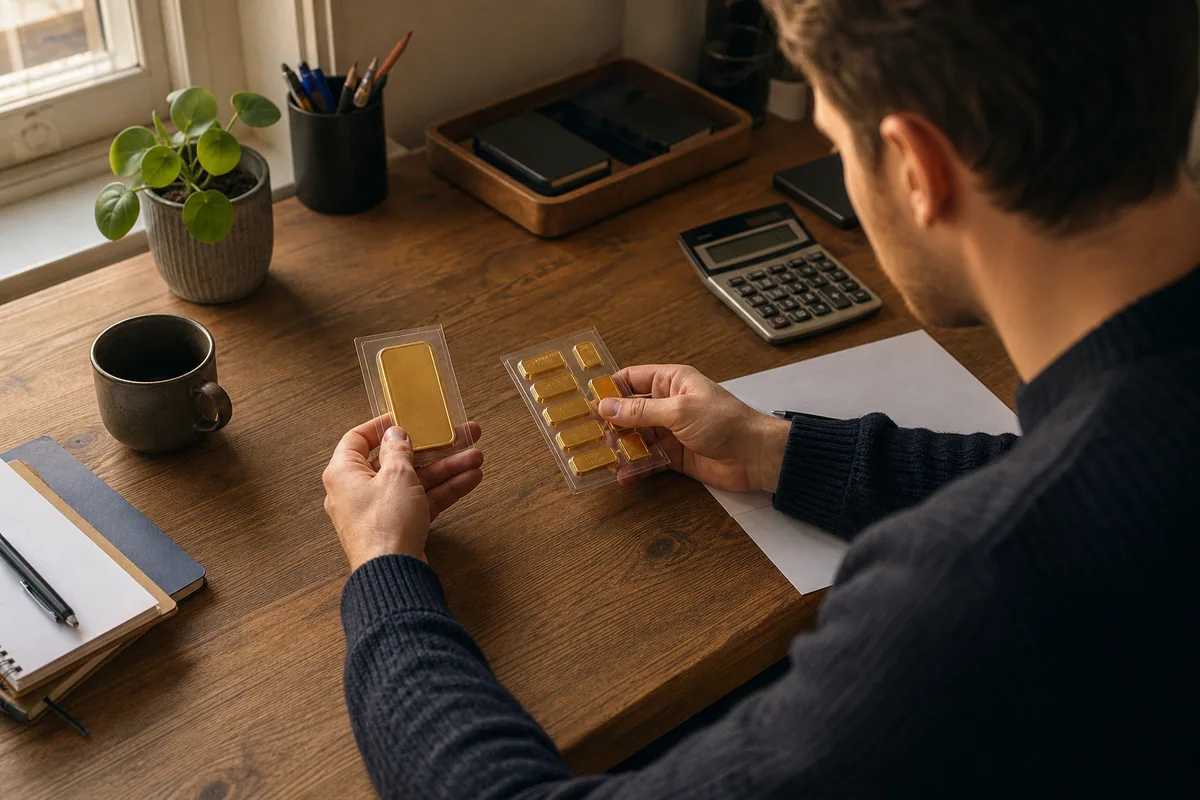
Imagine three realistic cash needs and note which unit would have to be sold. A single one-ounce bar is efficient only if selling the whole unit is acceptable. Ten one-gram bars permit fine-grained sales but may start with a large premium handicap. Mid-sized bars can offer a compromise, although repeated purchases may multiply delivery charges. Ask dealers for bids on each size, because the lowest buying premium is not automatically paired with the tightest resale spread. Confirm whether multi-bar sheets must stay intact and whether individual pieces retain identifiers. Avoid “combibar” or gift products unless their extra flexibility justifies their specific premium and resale treatment. The goal is not maximum unit count; it is an exit that matches plausible household amounts at a tolerable total cost.
Check refiner, packaging and verification terms
Choose a bar whose refiner and markings are readily recognised by the dealers likely to buy it. LBMA's Good Delivery List accredits refiners for institutional Good Delivery bars; it does not mean every small retail bar itself is a Good Delivery bar. Still, refiner provenance and responsible-sourcing controls can improve buyer confidence. Check weight, fineness, serial number where used, assay card and seal. Ask whether opening or damaging packaging changes the buyback price and how the dealer tests a secondary-market bar. Photograph packaging when received and keep the invoice separate from the stored metal. Avoid unsupported certificates, unfamiliar private labels and prices far below comparable metal value. Authenticity is a chain of product, seller, documents and handling, not a hologram alone.
Include storage and tax in the round trip
Bars are compact, but a household still needs a theft, fire and access plan. Check home-insurance limits and exclusions before assuming a safe is covered. Professional storage needs written title, allocation, audit, insurance, withdrawal and wind-down terms, plus an annual cost that may weigh heavily on a small holding. Qualifying investment gold is generally VAT exempt under HMRC rules, while UK CGT treatment differs from certain UK legal-tender bullion coins; review current guidance or seek advice for material disposals. Calculate purchase premium, delivery, custody, insurance, resale spread and insured return postage together. A lower premium can be erased by years of minimum storage fees. Compare dealer offers only after using the same custody horizon and exit assumptions for every bar size.
Often a better fit when
- Buyers comparing cost efficiency with the ability to sell in stages.
- Regular savers selecting repeatable bar sizes rather than novelty products.
- Owners who can document and securely store sealed bullion for years.
Pause or skip when
- The smallest bar absorbs an uncomfortable premium relative to its metal value.
- Selling a full one-ounce unit would exceed likely future cash needs.
- The refiner, assay information or secondary-market acceptance is unclear.
Buying checklist
- Convert every option to complete delivered cost per fine gram.
- Match unit size to a realistic partial-sale amount and backup cash needs.
- Verify refiner, purity, serial or assay details and packaging requirements.
- Obtain written buyback examples for sealed and opened packaging.
- Add storage, insurance, return postage and potential tax to the round trip.
Compare the route before the provider
Use our neutral framework to compare ownership, total cost, safeguards and exit terms.
Questions readers ask
Why do small gold bars cost more per gram?
Manufacturing, packaging, verification, handling and dealer costs apply to every unit. Spreading those costs over one or five grams generally creates a higher percentage premium than spreading them over an ounce. Compare delivered cost per fine gram and the dealer's buyback bid; the sticker price of one bar alone is not meaningful.
Should an assay card remain sealed?
Often yes, because some dealers prefer intact tamper-evident packaging and may adjust their process or price when it is damaged. Policies vary, and a seal is not independent proof of authenticity. Ask the intended buyer in advance, retain the invoice and avoid unnecessary handling while following the storage manufacturer's safety guidance.
Are one-ounce bars VAT free in the UK?
Bars meeting HMRC's investment-gold definition are generally VAT exempt, subject to the detailed rules. Check purity, accepted form and the invoice rather than assuming every bar qualifies. Jewellery, decorative products and some non-standard items can be treated differently. Review current HMRC guidance or obtain tax advice for unusual circumstances.
Sources and further checks
Sources were last reviewed on 2026-08-26. Rules and provider terms can change.